Rubens Santoro
Mongrassano 1859 - Napoli 1942
Born in Mongrassano di Cosenza on October 26, 1859, he briefly studied under Domenico Morelli at the Institute of Fine Arts in Naples. He honed his craft through numerous travels in Italy and abroad, with frequent stays first in Castellammare and Torre Annunziata, and later in Venice, where he made a home on the Grand Canal, and in Verona and Chioggia, sources of inspiration for many of his paintings.
He first came to the attention of critics and the public at the age of fifteen, that is, starting in 1874, the year he made his debut at the Promotrice Napoletana with three works: A Balcony, An Impression, and A Laughing Girl, the latter awarded a silver medal and purchased by Morelli. In the summer of the same year, he met the Spanish painter Mariano Fortuny.
Under the influence of Fortuny, Santoro produced several paintings, including In the Sun (Milan, Galleria d'Arte Moderna) and Houses in the Sun (works with which he would participate in the Brera Exhibition, Milan, 1878). Also in 1874, he sent a canvas to the Paris Salon, a city he would exhibit at several other times: in 1878 at the Universal Exhibition, where he represented Italian painting, an expression of official taste, with La grotte des bohémiens; in 1896 with Neapolitan Tinsmiths, an award-winning work, and Palazzo Van Axel in Venice; in 1897 with Meditation on a Terrace in Capri; in 1898 with Verona; and again from 1904 to 1909 with Verona, Canale della Latta (Venice), Grey Weather in Venice, and Twilight in Venice.
He then participated in the Neapolitan Promotrice in 1875; in 1876 he was in Genoa with two works; In 1877, at the age of eighteen, he exhibited at the National Exhibition of Fine Arts in Naples, with the works "Grotta degli zingari" (Gypsy Grotto), "Marina di Maiuri on the Amalfi Coast," purchased by Goupil.
From then on, he participated in the most important art events in Italy and abroad: the Promotrici di Torino (Promoters of Turin), the National Exhibition of Turin, with nine works; the Promotrici napoletane (Neapolitan Promoters); the National Exhibition of Fine Arts in Palermo in 1891-92, with the works "Interno" and "Pescarenico," which won a gold medal and were purchased by King Umberto I; the World Columbian Exhibition in Chicago, 1893; the Exhibition of the Society of Amateurs and Cultivators of Fine Arts in Rome; the First Artistic Exhibition of St. Petersburg, 1898; the National Exhibition of Milan, 1906; the International Art Exhibition of Buenos Aires in 1910; and the International Exhibition of Barcelona in 1911, which earned him a silver medal.
Other exhibitions included the Fiftieth Anniversary Exhibition in Rome, with After the Rain and The Ancient Chapel of San Benedetto; the 1921 Neapolitan Biennale; and the 1934 Colonial Art Exhibition in Naples. He exhibited at the Venice Biennale six times. His works were greatly appreciated by Adolphe Goupil, the famous Parisian art dealer, who at the time frequented the studios of the most important Italian painters. Goupil opened the doors of both that market and London to him. Santoro also frequented other famous art dealers, including Steweard in Paris and Colnaghi in London. He frequently stayed in London, where he was considered the most graceful Venetian landscape painter after Canaletto. One of his great admirers was Margherita of Savoy, who also introduced him to Tsar Nicholas II of Russia.
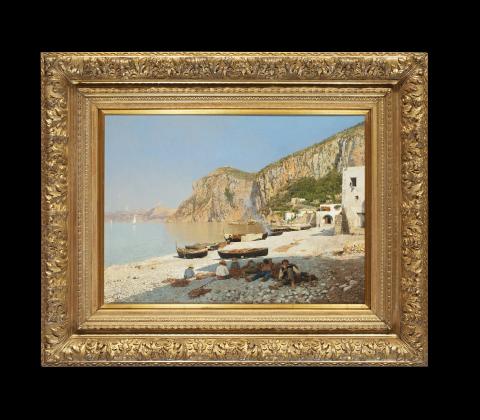
At the invitation of Frangipane, with whom he befriended, he participated periodically in the Calabrian Biennials in Reggio Calabria. His works are found in numerous museums and public buildings: Naples, Capodimonte; Milan, Gallery of Modern Art; Turin, Civic Museum; Reggio Calabria, Provincial Administration; Mongrassano, Council Chamber of the Town Hall; and private institutions and collections. His painting was immediately appreciated for the luminosity and transparency of his colors, his vigorous strokes, and the solidity of his tonal structure. He painted interior scenes, seascapes, numerous Venetian views, landscapes of Ischia and Pescarenico, and paintings inspired by his native town. He also painted portraits (Carolina Santoro, his wife, the Duchess of Aosta, Francesco Cilea) and oriental subjects (Moro, Naples, Provincial Administration). Upon Morelli's death, he succeeded him as professor at the Institute of Fine Arts in Naples.