Mosè Bianchi
Monza 1840 - 1904
Mosè Bianchi was born in Monza on 13 October 1840. After completing his technical studies at the Bosisio college, he enrolled at the Brera Academy in Milan in 1856. A pupil of Giuseppe Bertini, his fellow student was Tranquillo Cremona. He began to establish himself with The Archpriest Stefano Guandeca Accusing the Archbishop of Milan of Sacrilege (1862) and The Conspiracy of Pontida (1863), school essays that attracted general attention to the very young painter, so much so that the first of these was immediately purchased by the Society of Fine Arts. In 1864, having graduated from the Academy, he painted The Communion of Saint Aloysius Gonzaga for the church of Sant'Albino near Monza, and soon after, his first small genre painting, The Eve of the Festival (Brera Academy), a lively and vibrant scene, in which all the qualities that study and experience would refine and mature already appear.
In 1864, with a brief trip to Florence and Rome, Bianchi aimed to broaden his cultural horizons, something he was able to do in 1866 thanks to the Oggioni pensioner, whom he had won with The Vision of Saul. He stayed in Venice and Paris, where he met Mariano Fortuny and his works.
After all these experiences, Bianchi's painting seemed very refreshing, due to the attention given to atmospheric effects and the breezy technique, similar to that of Mariano Fortuny.
In 1868, he reappeared at the Brera exhibitions with two excellent portraits and several smaller canvases, and triumphed the following year with one of his finest and best-known works, The Brothers in the Field (Brera Art Gallery). By now, the artist's fame was assured, and his extensive, orderly, and tireless output was confirmed year after year: in 1870 with the Blessing of the Houses (Brera Academy), with Cleopatra (first version in 1865 and then replicated in 1872), in 1874 with an Interior of the Cathedral of Monza (exhibited at Brera and later purchased by the King of Belgium), in 1879 with the Crucifix and with the Stormy Lagoon at Chioggia, which was the first of the series of works that raised his name so high.
In 1888, he exhibited in Bologna, along with other paintings, Parola di Dio (National Gallery of Modern Art, Rome), and seven years later, driven by domestic circumstances to spend the autumn months in the mountains, especially in Gignese on Lake Maggiore, he turned his studies to Alpine life and its mountain dwellers.
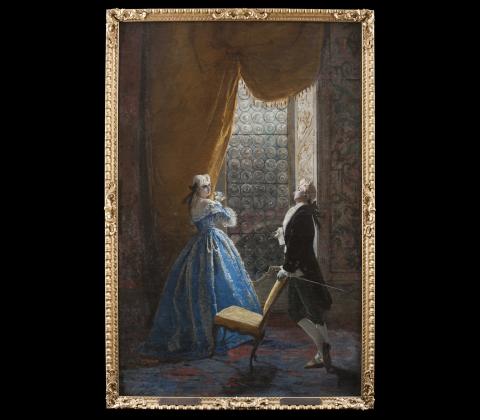
Bianchi's best work remained in his youthful Lavandaie (Washrooms) or in his freer and more concise sketches from life, such as Lavoro della Terra (Work on the Land), from the Vernocchi collection in Gallarate, from 1887. In his later years, he seemed to abandon his lively conception of reality for more classical investigations of form, as in Bagno Pompeiano (Pompeian Bath), La Mandolinata (Mandolin Dance), and Prima del Duello (Before the Duel), a radical revival of the eighteenth-century genre. But even more important, for a true appreciation of Bianchi's talent, is a nearly overlooked aspect of his work: that of a brilliant draftsman, as highlighted in the series of albums from the Civica Raccolta Bertarelli at the Castello Sforzesco in Milan, and that of an etcher, a side that until now had been almost forgotten but now brought back to prominence by the reprint of thirty-five original copperplates from the antique A. Fusetti copperplate, curated by its new owners. The practice of etching, with its relentless technical and creative research, accompanied him throughout his life.
Bianchi died on March 15, 1904, in his native Monza.