Louis Ernest Barrias
Paris 1841 - Paris 1905
Louis-Ernest Barrias was born in Paris on April 13, 1841, into a family of artists; his father was a porcelain decorator, while his brother was an acclaimed painter.
He trained at the École des Beaux-Arts in Paris under sculptors Cavelier and Cogniet, though he did not complete the full course there, moving instead to study under François Jouffroy. He distinguished himself in the 1865 Prix de Rome competition, winning a scholarship that allowed him to continue his training at the French Academy in Rome. He also contributed to the decorative work for the Paris Opéra and the Hôtel de la Païva on the Champs-Élysées.
After his time in Rome, he returned to France with a classical style inspired by Italian Renaissance art.
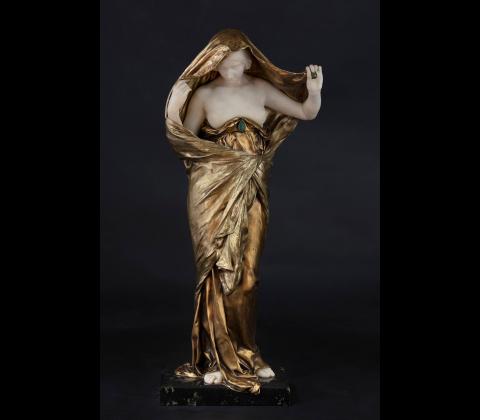
Later, however, his style shifted toward Romanticism, while also incorporating elements of contemporary movements such as Art Nouveau. Although he primarily produced marble sculptures, he also experimented with combining materials such as marble, hardstones, bronze, and ivory.
Barrias received numerous honors, including appointment as a Knight of the Legion of Honour in 1878, Officer in 1881, and Commander in 1900.
He went on to teach at the Institut de France and later served as a professor at the École des Beaux-Arts, succeeding his mentor Cavelier.
He died of influenza on February 4, 1905, at his home in the 17th arrondissement.
His works can be found in public spaces across Paris, at the Musée d’Orsay, in museums worldwide, at the Père Lachaise Cemetery, and in numerous private collections.