John William Godward
Wimbledon 1861 - Fulham 1922
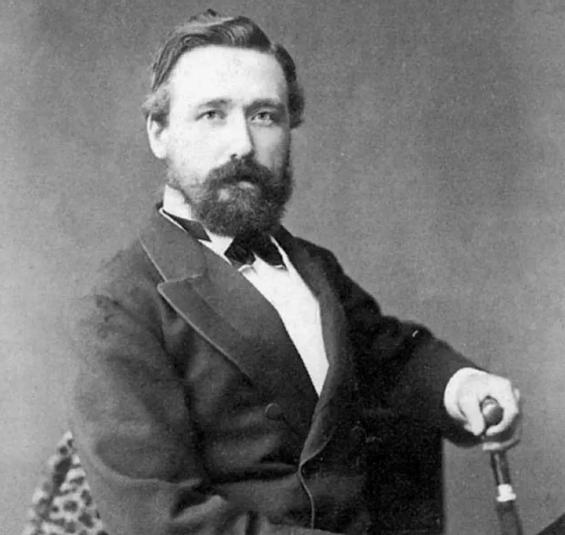
John William Godward was born in 1861 in Wimbledon; his father worked for an insurance company. The family firmly opposed Godward's artistic aspirations, preferring a better future for their firstborn.
His parents' tyranny throughout his childhood left Godward with a reserved and introverted personality.
Despite these obstacles, the young painter managed to gain recognition in his contemporary art scene, becoming a protégé of Sir Lawrence Alma-Tadema (1836–1912), a symbol of Victorian Neoclassicism.
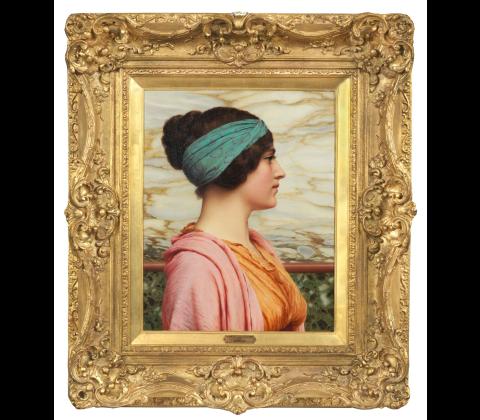
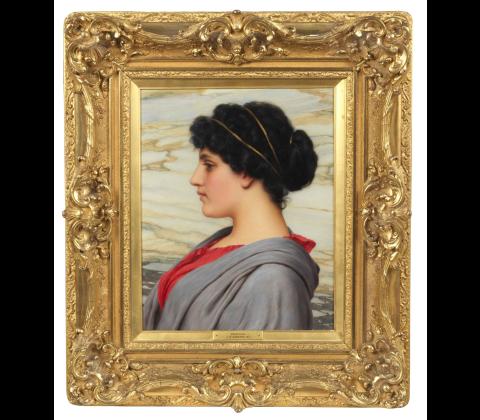
From his master, he borrowed themes and atmospheres, especially the settings and marble backgrounds. Godward's figures are immersed in a dreamlike, fairy-tale-like antiquity, brought to life by vivid palettes and evanescent brushstrokes.
From 1887, he exhibited at the Royal Academy at Burlington House until 1912, when, in love with one of his Italian models, he moved with her to Rome. There, he developed a friendship with the artist Roberto and his son Augusto Bompiani, also a painter, who shared a fervent passion for archaeology and classical architecture. Following his trip, Godward's relatives definitively cut ties with him.
In 1921, he returned to England; abandoned and disillusioned by the unstoppable change brought by the avant-garde, he committed suicide the following year. Once again, his family condemned his memory: to atone for the shame of his suicide, they implemented a sort of damnatio memoriae, destroying and burning every photo, drawing, and writing of the artist in their possession.