
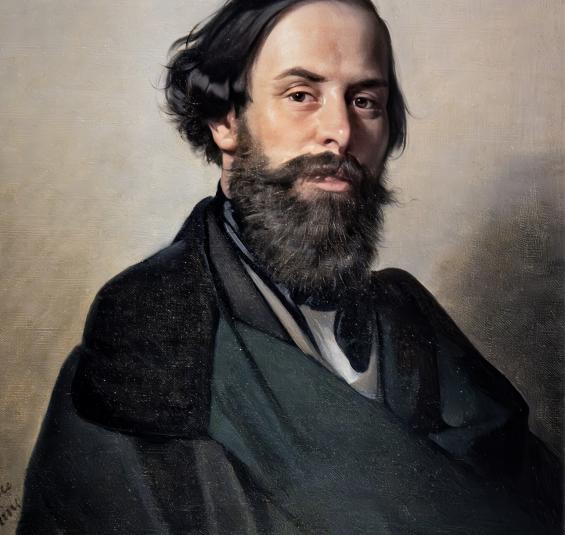
Ippolito Caffi
Belluno 1809 - Lissa 1866
Ippolito Caffi was born in Belluno on October 16, 1809. He began his artistic training first in his native city, then moved to Padua, and finally to Venice at the Academy of Fine Arts, from 1827 to 1831.
He had the opportunity to study Venetian vedutisti and perfect his perspective drawing skills, winning prizes.
The following year, Caffi decided to move to Rome to continue his training in the veduta genre. In early 1883, he opened his own studio, dedicating himself to life painting and drawing, becoming one of Italy's leading urban landscape painters.
His vedute were distinguished by their evocative luminosity, made even more dramatic in night scenes where moonlight, fireworks, or fog dominate, and by their great topographical and architectural precision.
Indeed, in 1835 he published Lezioni di prospettiva pratica (Lessons in Practical Perspective), demonstrating his mastery of spatial composition.
Around 1840, Caffi left Rome and embarked on several journeys: first he stopped in Naples, and from there he headed east to Athens, Turkey, Palestine, and Egypt, creating numerous sketches that later inspired his paintings. He returned to Italy in 1844.
In 1848, he decided to leave Rome and move to Friuli, where he enlisted to fight against Austria. Caffi was deeply involved in the revolutionary causes of the Italian Risorgimento and painted many scenes celebrating Italian independence.
After escaping from prison, he stayed in Venice, then Genoa, Switzerland, and finally Turin in 1850.
He subsequently had the opportunity to make several trips to London, where he exhibited at the Universal Exhibition, and then to Paris and Spain.
After the unification of Italy, Caffi returned to Venice and resumed painting.
In 1866, during the Third Italian War of Independence, Caffi boarded the Italian warship Re d'Italia to document the naval campaign. He died when the ship sank during the Battle of Lissa on July 20, 1866.
Today, Ippolito Caffi is considered one of the greatest Italian landscape and urban painters of the 19th century. His innovative approach to light, atmosphere, and urban life anticipated aspects of later landscape painting and has led to a renewed appreciation of his work. Important collections of his paintings are held in museums such as Ca' Pesaro in Venice and the Civic Museum of Belluno.