Giovanni Muzzioli
Modena 1854 - 1894
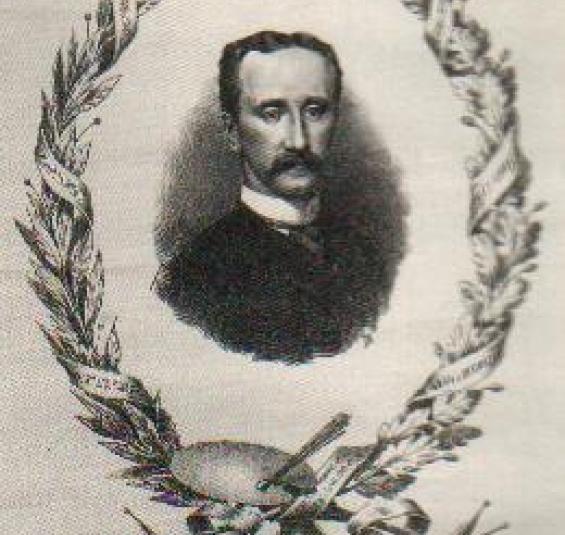
Giovanni Muzzioli was born in Modena on February 10, 1854. After completing high school, in 1867 he entered the Academy of Fine Arts in his hometown, then directed by Adeodato Malatesta, a champion of the purist revival and later of Domenico Morelli's historical realism. He made his debut at the 1872 National Exhibition in Milan, where he presented a Beheading of St. John, nude studies, and drawings from casts of statues and reliefs by Donatello and Mino da Fiesole. That same year, with Rebecca at the Well, but especially with Torquato Tasso at the Hospital of St. Anna, characterized by a conscious adherence to Morelli's realism in the naturalness of the pose, he won the Poletti Prize, which took him to the Accademia di San Luca in Rome for the first three years and to Florence for the final year. In 1873, he moved to Rome. His first two years are epitomized by his copy of Giulio Romano's Justice in the Hall of Constantine in the Vatican (1873-74) and Abraham and Sarah at the Court of Pharaoh (1874-75), which was a revelation in iconography and style, overturning the conventions of the biblical subject by reconstructing a scene from ancient Egypt with a truthfulness drawn from his study of ancient monuments and his attention to contemporary experiences in opera.
In 1876, he moved to Florence to complete the final work of the three-year period: Poppea with Nero Carrying the Head of Octavia, which was constructed on an unprecedented subordination of the main subject to the overall impression of the scene, relegating the emperor to the shadows and background. Exhibited at the Academy of Fine Arts in Florence, the work was exhibited again at the end of the same year in Modena, where it earned the author an honorary professorship at the local Academy.
In Florence, he soon came into contact with the leading exponents of Tuscan naturalism and Macchiaioli painting; he developed relationships with the "Parionisti" group and the Florentine artistic circle. His association with this circle stimulated a reflection on landscape, which was initially overshadowed, however, by the success of his historical paintings, portraits, and genre scenes set in Rome.
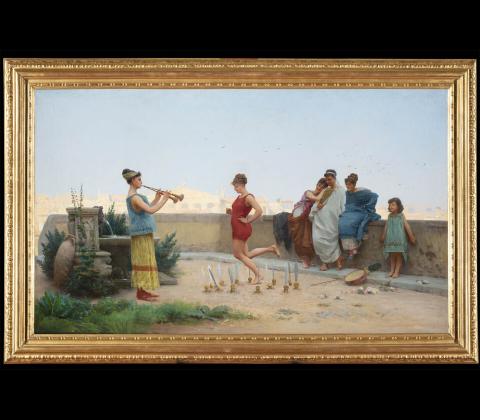
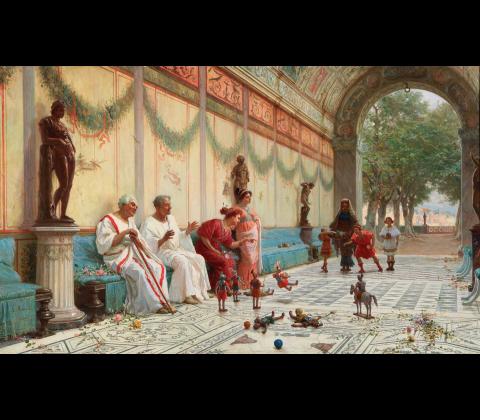
At the 1878 Universal Exhibition in Paris, where he closely studied the work of Sir Lawrence Alma-Tadema, he deepened his reflections on so-called genre history painting. His painting The Sword Dance was applauded at the 1880 Turin Fine Arts Exhibition, where he also presented Poppea Asking for the Head of Octavia and The Magdalen. In 1880, he began contributing to the Modena newspaper Mutina - Mutina. In 1881, his work At the Temple of Bacchus won the Cantù Prize at the National Exhibition in Milan. Dating from this period are Rite in Ancient Greece or Bacchanal and Roman Scene, which interpret the pagan world with a modern sensibility. The Pink Cart, exhibited in 1882 at the Florentine Artistic Circle, reveals a new attention to everyday life.
His first landscapes, exhibited in 1881 at the Florentine Promotrice, date from the same period: In the Farmyard and Landscape; Hot Hours and Tranquil Life; The Olive Harvest and At the Well; Afternoon and In Sight.
Having become a member of the Florentine Artistic Circle in 1882, he served as its advisor and third president. He was subsequently advisor to the local Promotrice, the Society for the Encouragement of Fine Arts of Florence, and an honorary professor of merit at the local academy.
Dating from the second half of the 1880s, alongside commissioned works with elegiac and gallant themes (For the Festival, Roman Woman with a Garland of Flowers, Fontinalia, and Courtship), he produced bourgeois interior scenes, such as The Shawl (1886), The Little Sisters, and scenes of everyday life en plein air, such as In the Park.
His work, The Funeral of Britannico, was particularly successful at the 1888 National Exhibition of Fine Arts in Bologna.
In 1891, he was elected to the Fine Arts Council at the Ministry of Education, working from 1893 on the Acquisitions Committee of the Galleria d'Arte Moderna in Rome; a large group of portraits date from this period.
In 1893, he returned to Modena, where he died on August 5, 1894.