
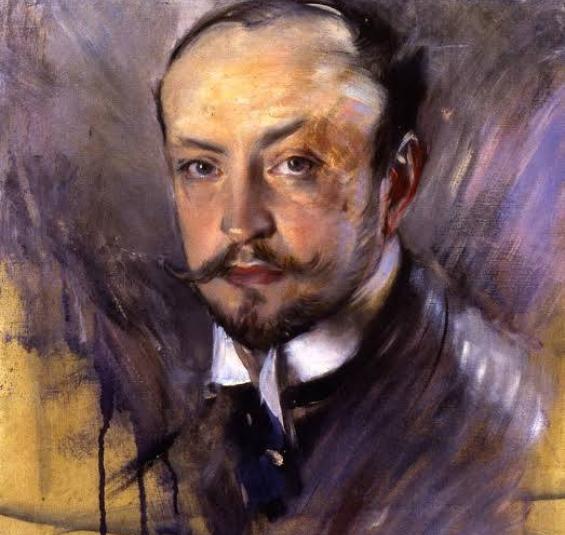
Giovanni Boldini
Ferrara 1842 - Paris 1931
Boldini was born on December 31, 1842, in Ferrara to an artist father. After receiving his initial training from his father Antonio, his academic education took place at the Academy of Fine Arts in Florence, a city he had moved to because it was more stimulating. At the Academy, he studied under Stefano Ussi and Enrico Pollastrini. He then came into contact with the Macchiaioli circle at the Caffè Michelangiolo; their research into the rendering of natural light had a profound influence on him. The painting genre that most interested him was portraiture. In Florence, he painted portraits of many of his friends, such as Giovanni Fattori and Vincenzo Cabianca, as well as influential figures from the social circles. The network he built among European nobles who frequented Florence, fellow artists, and intellectuals benefited his artistic development and career opportunities. In 1866, he participated in the Promotrice Fiorentina with some works that were particularly appreciated by Telemaco Signorini. After his success in Florence, however, a growing sense of restlessness and limitations regarding his art grew within him, and he began to travel.
Thanks to the patronage of Mr. Cornwallis-West and the Duke of Sutherland, Boldini moved to London, where he received numerous commissions from English aristocrats. The destination that interested him, however, was Paris, a cosmopolitan city, rich in stimuli and opportunities for artists. In 1871, he moved there permanently. He made contact with the Impressionists, particularly Edgar Degas, and cultivated a business relationship with Adolphe Goupil, who had already gathered under his wing a group of painters such as Giuseppe de Nittis, Ernest Meissonier, Giuseppe Palizzi, and many others. Boldini consolidated his position and began to penetrate the sophisticated world of Parisian salons, as well as the world of exhibitions, participating in the Salons. He perfected his portrait painting style and secured numerous commissions.
From 1876 onwards, he traveled extensively: to Germany, the Netherlands, Spain, Morocco, Switzerland, and back to London, before arriving in New York in 1897, where he exhibited at the Galerie Wildenstein.
In the early 20th century, Boldini returned to Italy to exhibit and paint portraits; he also received official recognition (Grand Officer of the Order of the Crown of Italy). During the First World War, Boldini moved first to London and then to Nice, finally returning to Paris in 1918, where he remained until his death in 1931.
He was buried, as per his request, in the Monumental Cemetery of the Certosa di Ferrara.
Boldini is remembered as one of the greatest Italian portraitists. His distinctive style was characterized by broad brushstrokes that conveyed a sense of movement and a unique brilliance that created dynamic yet elegant portraits.
His works were an expression of modern portraiture, which made Boldini one of the leading artists of the Belle Époque.
The Phidias Gallery had the pleasure of hosting the work "Pastello Bianco," a portrait of Emiliana Concha de Ossa. Emiliana, a young Chilean model, was portrayed by Boldini at the age of eighteen using pastel, playing with light tones of gray, white, and cream.
The painting was exhibited at the Boldini and Fashion exhibition, held in 2019 at the Palazzo dei Diamanti in Ferrara, and is published in the artist's Catalogue Raisonné, edited by Pietro Dini and Francesca Dini, on pages 270-271.