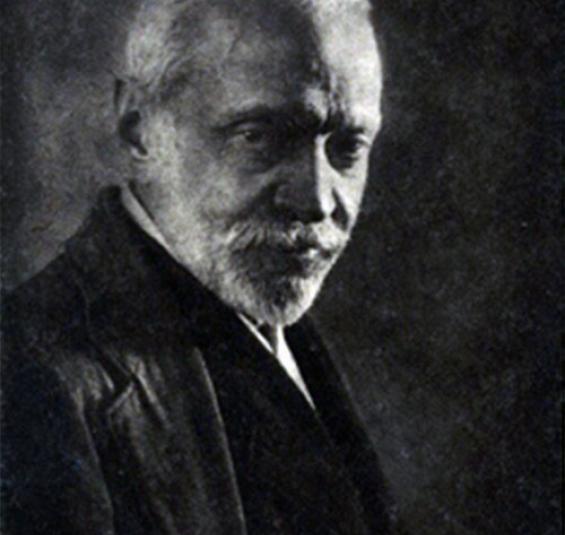
Gaetano Bellei
Modena 1857 - 1922
Gaetano Bellei was born in Modena in 1857 and trained as an artist under the guidance of Adeodato Malatesta at the Modena Academy of Fine Arts, before completing his studies at the Accademia di San Luca. In 1876, while still a student, he won the Poletti Prize competition in Modena with his historical painting "Il Francia che admira per prima vista la Santa Cecilia di Raphael" (France Admiring Raphael's Saint Cecilia for the First Time), now in the Museo Civico di Modena, which earned him an artistic pension. He then traveled to Florence, where he met Gaetano Chierici, who inspired his narrative composition. Encouraged by the English antique dealers and patrons Bredling and Strange, he devoted himself entirely to genre painting.
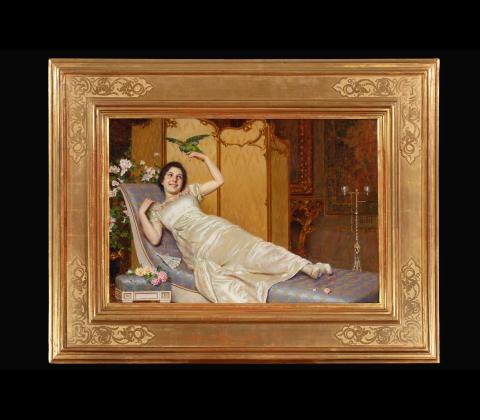
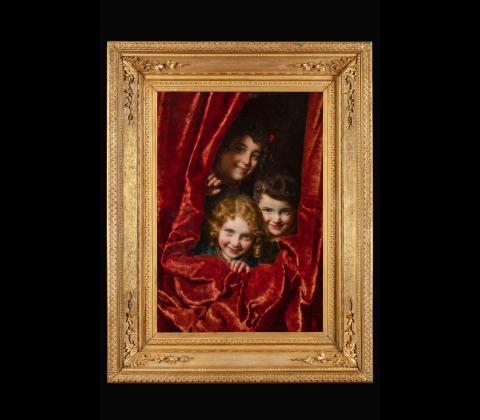
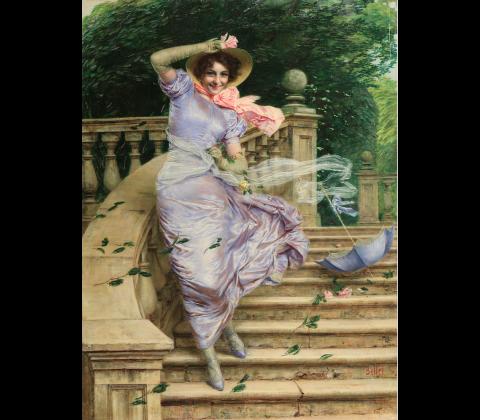
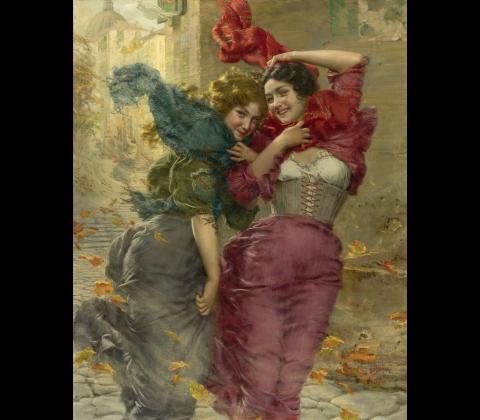
These scenes typify Bellei's early artistic career, whose themes were repeated and replicated with few variations, such as "Briscola in the Convent" and "Primi passi" (First Steps), as they were highly sought after by collectors and patrons. The cheerful subjects of his paintings are combined with a commendable technical mastery of the medium, accompanied by the artist's desire to keep pace with contemporary European trends. In 1882, he brought La Benvenuta to the Exhibition of the Royal Academy in London, which brought him fame in Anglo-Saxon circles. In 1885, he exhibited Il micino fortunate (The Lucky Kitten) for the first time in Genoa, a subject so commercially successful that it was painted in several versions. From 1893, he taught at the Modena Academy, but continued to participate in various exhibitions, including Turin in 1898, Milan in 1906, Genoa in 1910, and Rome in 1911. Bellei established himself as a painter of human affections, the simple daily life of men, often farmers; the subjects most frequently portrayed were elderly people and children, often captured in joyful moments of play. Genre scenes, very popular among wealthy patrons, brought him artistic success and financial well-being throughout his life. In the first decade of the 20th century, he continued to experiment with contemporary movements, including Divisionism and Art Nouveau.
He died in Modena in 1922.