Francesco Vinea
Forlì 1845 - Florence 1902
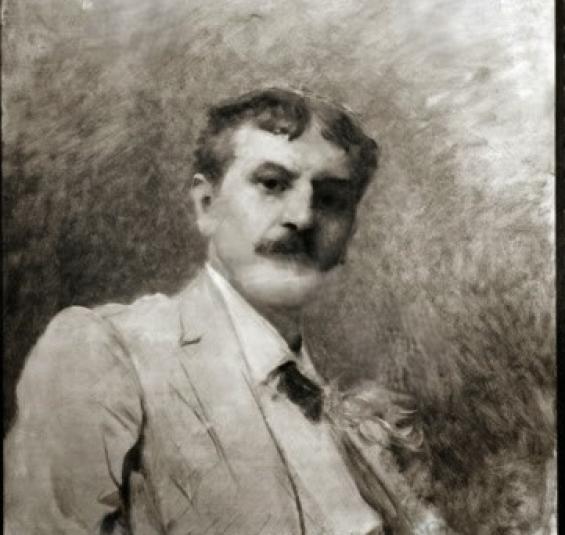
Francesco Vinea was born in Forlì in 1845 to a family of modest origins; his early education was troubled and uneven. His aptitude for drawing was immediately evident, and at just 14 years old, he moved to Florence to enroll at the city's Academy of Fine Arts. There, he attended the classes of the painter Enrico Pollastrini (1812–1876), briefly exploring Romantic poetry. He made his debut at the 1861 Florence National Exhibition with Ritratto muliebre, a painting that reveals his interest in the study of the female nude. He subsequently devoted himself to historical painting, favoring genre scenes in costume with light-hearted, worldly themes, while also taking on more solemn commissions in the vein of Jean Louis E. Meissonier. As early as 1863, he painted Michelangelo Reciting His Verses to Vittoria Colonna for the royal apartments of the Pitti Palace.
Due to severe financial difficulties, the young Vinea was forced to interrupt his studies and take up a job that guaranteed him a stable income, introducing him to the world of photography and illustration. This profession allowed him to develop his skill in rendering detail and to study 18th-century Italian painting in depth.
During his intense career, he participated in countless national and European exhibitions, where his historical reconstructions, imbued with a cheerful atmosphere and vibrant colors, were highly sought after by various art dealers, including the renowned Adolphe Goupil and Luigi Pisani. The widespread success he achieved in France, England, and Germany ensured him a comfortable existence, as evidenced by the purchase of a summer residence in Pracchia, in the Pistoia Apennines. In his studio on Viale Principe Eugenio, Vinea worked tirelessly and incessantly on works with a luminous palette and refined textures. His subjects, adapted to the tastes of international collectors, are depicted with festive elegance and amiable frivolity.
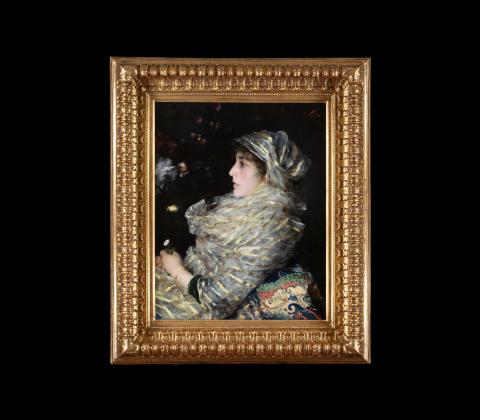
The artist's work ranges from genre scenes such as Breakfast in the Countryside and Wedding Procession to historical works such as Musketeers and Before the Duel (now at the GAM in Milan), also dedicating himself to graceful female nudes, such as A Solitary Bather and Odalisque.
His paintings of charming young women were highly appreciated, often immersed in flower gardens or graceful interior scenes, depicted sipping tea, engaged in romantic reading, or strolling in the park with their pets. Among these works are Young Girl in the Garden, The Cup of Coffee, and Tea Time.
Despite the almost exclusively decorative nature of his work, Vinea represents one of the most significant examples of late-19th-century genre painting, perfectly embodying the bourgeois spirit of his era. He died at the height of his career in 1902 in Florence, at just fifty-seven years old.