
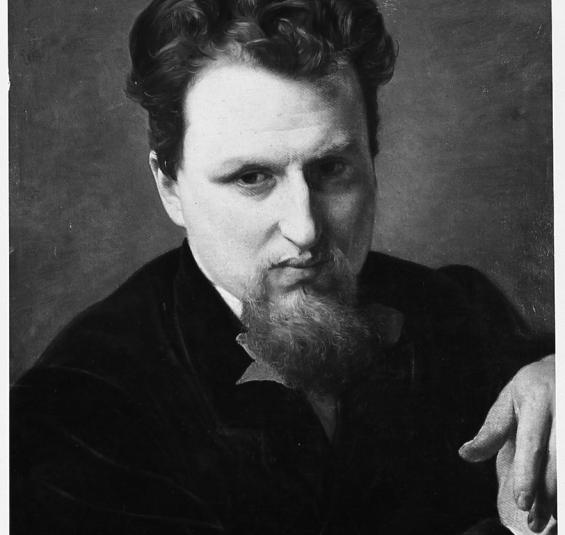
Egisto Sarri
Figline Valdarno 1837 - Florence 1901
Luigi Egisto Sarri was born in 1837 in Figline Valdarno, in the province of Florence. From a poor family, Sarri attended one of the schools for the less well-off run by the educator Lambruschini; meanwhile, he helped his father Raimondo, a house painter, with his work. At just eleven years old, he showed a marked aptitude for painting and drawing and, encouraged by his parents, enrolled in the Academy of Fine Arts in Florence in 1850. Admitted to the School of Drawing and Figures thanks to a drawing of his depicting Guercino's Ecce Homo, he settled permanently in Florence to continue his studies, financially supported by the community of Figline and the Confraternity of the Misericordia. In 1854, he enrolled in the School of Painting of the Romantic artist Giuseppe Bezzuoli (1784-1855), and after his death, he began studying with the Italian-Swiss painter Antonio Ciseri (1821-1891). Despite awards and accolades from his teachers, Sarri's financial situation remained precarious, forcing the young artist to work on poorly paid commissions. In 1857, he painted Lorenzo de' Medici Escaping the Conspirators' Dagger in the sacristy of Florence Cathedral for an Academy competition, in which he unfortunately failed to place among the top places, as Ciresi regretfully noted in his diary. At the 1861 Solemn Exhibition of the Society for the Promotion of Fine Arts, Sarri exhibited a canvas he had painted a few years earlier, depicting Lorenzo de' Medici, which was later purchased by a local lord. During his youth, the artist combined Ciresi's teachings with the realist but less academic approach of the Neapolitan School, following in the footsteps of Domenico Morelli.
In 1863, King Victor Emmanuel II commissioned him to paint Corradino di Svevia Chevalier des Présentation, on which he experimented extensively with light and color, failing to achieve the desired results, so much so that he left it unfinished. That same year, he began his prolific career as a portrait painter, sometimes employing photography, as in the Portrait of Gioacchino Rossini (1866), the portrait of Victor Emmanuel II of Savoy (circa 1870, now in the Palatine Gallery of the Pitti Palace), and Giuseppe Verdi, the latter two created from photographs by the Alinari brothers. In 1865, he painted the frescoes on the piano nobile of the Crispi house in Florence; however, two years later, he increasingly withdrew to his studio, excluding himself from the more sophisticated Florentine art scene. Catering to the French and English markets, in 1875, Sarri began a fruitful series of paintings depicting domestic scenes from Pompeii, which continued until at least 1887 and earned him considerable financial success.
Toward the end of the 1870s, critics rediscovered a renewed interest in historical paintings, as demonstrated by the 1880 Turin National Exhibition. For the occasion, he painted Jacopo Guicciardini Rebuking Clement VII for the Siege of Florence, a work that, however, was not accepted at the Exhibition. Also from the same period is Alessandro de' Medici Kidnapping a Nun, now housed in the Palazzo Pretorio of the municipality of Figline Valdarno. In addition to illustrious portraits, the painter was commissioned to create curtains and frescoes for several theaters in the province of Florence, as well as a series of religious canvases for monasteries and minor churches. In 1900, he entered the competition sponsored by Vittorio Alinari with the painting Apotheosis of the Madonna, now in a private collection, and in 1901 he completed his Self-Portrait, now in the Uffizi. He died in November of the same year; his son Corrado (1866-1944) became a painter himself, and primarily an illustrator of children's books.