Cesare Dell'Acqua
Pirano d'Istria 1821 - Ixelles 1905
Cesare Dell’Acqua was born in Piran d’Istria in 1821. Following the death of his father Andrea, a judge, the family moved to Koper, the Dell’Acquas’ hometown, in 1826. He began an academic career, which he continued in Trieste, but was forced to interrupt his studies due to financial constraints. From 1833, he worked a modest job at the shipping firm Parisi & C., practicing drawing and pursuing his calling. One of his sketches was noticed by the sculptor Pietro Zandomeneghi, who, along with other Venetian artists and patrons, including the historian Pietro Kandler, managed to secure a scholarship from the Municipality of Trieste to allow the young Dell’Acqua to study painting at the Academy of Fine Arts in Venice. At the age of twenty-one, he began his true artistic journey, debuting in 1843 at the Fourth Exhibition of the Trieste Society of Fine Arts. The following year, the city of Trieste commissioned him, along with landscape artist Alberto Rieger, to produce a series of fifteen lithographs commemorating the celebrations for the official visit of Austrian Emperor Ferdinand I and his wife Maria Anna of Savoy, making him well-known in aristocratic circles, primarily Austrian. After completing his studies at the Venetian Academy in 1847, he set out on a European tour, stopping in Vienna and Munich before arriving in Paris early the following year. He remained in Paris for a short time due to the outbreak of the Third French Revolution, evidence of which remains in Dell'Acqua's sketchbook, now in the Louvre. The artist then moved to Brussels, where his older brother Eugenio had already been living for years.
Dell'Acqua continued to integrate into the Belgian artistic and multicultural environment, joining the Cercle Artistiques et Littéraire and becoming a student of the history painter Louis Gallait, a choice that was no coincidence: "history painting," that is, depicting scenes from secular Western history, was considered by the academies of the time to be the most prestigious form in the hierarchy of genres. During the same period, in keeping with the Romantic movement, he presented a work dedicated to Niccolò Machiavelli at the Brussels Exhibition. In 1855, he married a young woman from a good Belgian family, with whom he had two daughters, strengthening his ties with local society and the local area without ever forgetting Trieste, continuing to manage its patronage. His talent and executive ability earned him important commissions from Archduke Maximilian of Austria: on the occasion of his marriage to Princess Charlotte of Belgium, celebrated in Brussels in 1857, he was summoned to paint the ceremony from life, and was subsequently hired to decorate Miramare Castle in Trieste with a historical cycle.
The artist received numerous military honors, bestowed upon him by King Leopold, who named him a Knight of his Order in 1863, and subsequently by Maximilian of Austria, who appointed him an Officer of the Order of Guadalupe the following year.
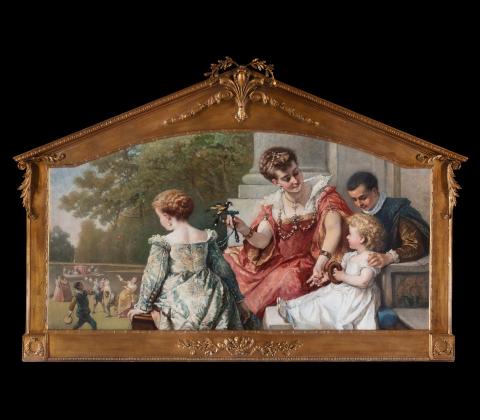
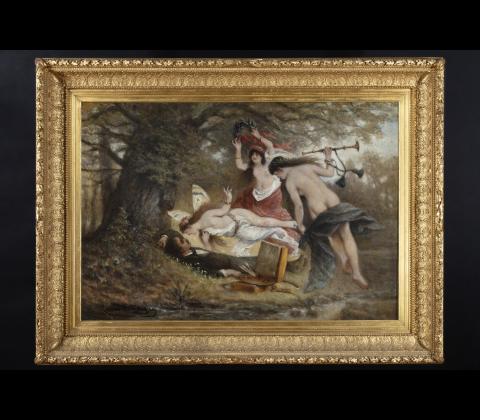
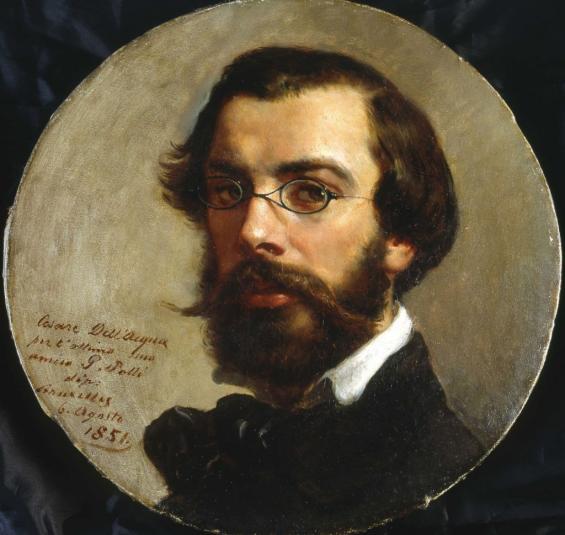
An extremely prolific artist, in the early 1870s he distanced himself from the Romantic and historical academic currents to create works with a decorative taste inspired by the Venetian Renaissance, especially Titian and Veronese. These pictorial cycles, with their spectacular yet refined taste, earned him prestigious commissions, including those from the Italian Consulate at the Palazzo Herrera and from Philip, Count of Flanders, brother of the King of Belgium. He made his international debut with his participation in the Vienna Universal Exhibition of 1873 and the London International Exhibition the following year, sending his works to exhibitions throughout Europe, as well as to the United States and Australia. In 1874, the Uffizi Gallery in Florence asked him to submit a self-portrait to their museum's gallery of celebrated painters; subsequently, the Academy of Fine Arts in Milan named him an honorary member of its Committee. After a life of celebrated success, he died in the municipality of Ixelles in 1905; shortly thereafter, the aforementioned Cercle Artistiques et Littéraire, of which he was a member, dedicated his first impressive perspective to him.
His works are now preserved in the museums of Aversa and Brussels, in the Collections of the Belgian Royals, as well as in Venice, Padua, Piran d'Istria, Koper and above all Trieste, in the Civic Museums, at Miramare Castle and at Villa Vianello.