Beppe Ciardi
Venice 1875 - Quinto di Treviso 1932
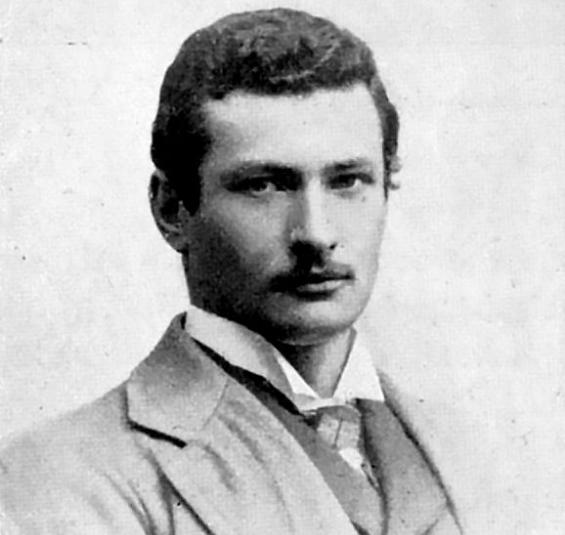
Beppe Ciardi, born Giuseppe, was born in Venice in 1875. Born into an artistic family, his father was the landscape painter Guglielmo Ciardi, known primarily for his views of the Venetian lagoon. His younger sister, Emma Ciardi, also became an established and internationally acclaimed painter.
Beppe's first contact with painting was thanks to his father, as evidenced by a composition of three Alpine landscapes dated between 1888 and 1892, now held by a private foundation in Treviso. Despite his son's evident aptitude and precocious talent, Guglielmo did not approve of his son's future as an artist, preferring instead a scientific career. Beppe was forced to enroll in the Faculty of Natural Sciences at the University of Padua, where he attended for three years. Preceded by the fame of Guglielmo, who in the meantime had been appointed Professor of Landscape at the Royal Institute of Fine Arts in Venice, Beppe made his debut at the second edition of the Milan Triennale with some life studies.
Meanwhile, he neglected his university studies to devote more and more time to painting: in 1896, he left the university to enroll in the institution where his father taught, but chose not to follow his father's course; instead, he enrolled in figure drawing, the chair of which was then held by the painter Ettore Tito. That same year, he presented two still lifes at the International Art and Flower Exhibition in Florence.
At the Third Venice Biennale in 1899, in which both father and son participated, Beppe made his national debut with the triptych Terra in Fiore and Monte Rosa, a moderately sized painting.
After completing his studies at the Academy, Beppe began to devote himself to portraiture, both family portraits and commissioned portraits, and to outdoor genre scenes. Landscape continues to be present, but in a more subdued manner: it serves as the backdrop to tender childhood moments, featuring little girls intent on their games (as in Meadow Flowers, c. 1900) or young rascals (Bathing or Boys on the River, 1899). The artist's life studies of the Roman countryside and the rural life of the common people would later be used for the triptych Parable of the Lambs, presented at the Milan Triennale in 1900 and for which he won an award.
Also during this period, Beppe embarked on a Symbolist journey, clearly influenced by German painting, especially by Arnold Bocklin, as in Moonlight Garden (1900).
Between 1905 and 1907, the artist returned to the spring setting from his early works, dedicating himself to a series of canvases where the predominant theme is once again childhood; Laughing children, flowers, and almond trees often feature, as in Butterflies or Smiles, exhibited at the 7th Venice Biennale.
An artist with a reserved and introverted personality, his works clearly reflect a continuous conceptual reflection on human emotions and the bonds they intertwine, as evidenced by the presence of numerous versions of canvases addressing the themes of motherhood, departure, but also spring as a symbol of youth and rebirth.
With Italy's entry into the war in 1915, the Ciardis retired to their home in Quinto di Treviso; the following year, Guglielmo, Beppe, and Emma exhibited in the exhibition named after them at the Galleria Centrale d'Arte in Milan, where our painter achieved great success.
During the 1920s, he reached artistic maturity: his brushstrokes are lively and fragmented, and his layers become charged with pictorial matter.
In 1924, the artist was appointed to the Board of Directors of the Biennale, later opening a small solo exhibition at the Galleria Corona in Naples. That same year, he painted his most famous Self-Portrait, now housed in the Uffizi Gallery: depicted in the guise of a painter, with palette and easel, Beppe immerses himself in the rural landscape that had characterized his work for decades.
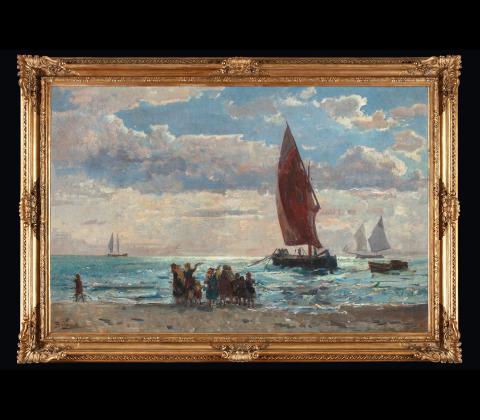
During the last years of his life, the artist's style became immediate and synthetic, his landscapes depicting uncontaminated, rugged, and acrid nature (Sunset on the Sile, 1928). His brushstrokes, on the other hand, became dense and layered, divided into strands of color, in a highly personal interpretation of Divisionism.
In 1932, he participated in his last Biennale with three large-scale works, depicting a view of the Piave River, a seascape, and a scene of rural life; he died that same year.
His paintings are now preserved in the most important national and international museums and are highly sought-after by private collectors.