
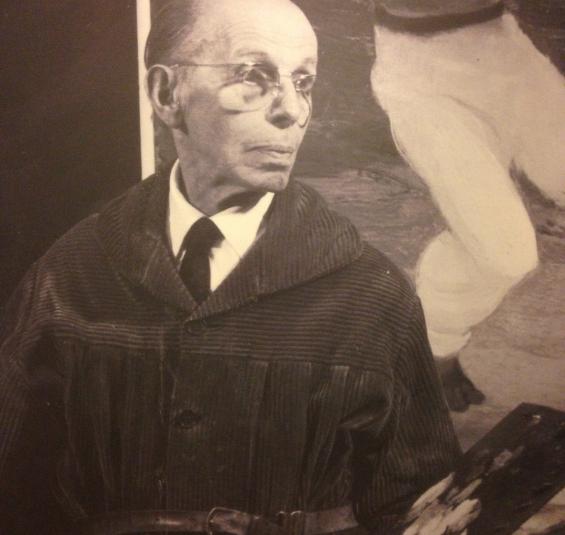
Amedeo Bocchi
Parma 1883 - Rome 1976
Bocchi was born in Parma on August 24, 1883, to a father who was a decorator. His education began at the Royal Institute of Fine Arts in his hometown; after graduating in 1901, he continued his studies in Rome at the Scuola Libera di Nudo.
There he met artists such as Giovanni Costa, Giulio Aristide Sartorio, Giacomo Balla, and Duilio Cambellotti, while deepening his study of the works of Matisse, Renoir, and Klimt.
Bocchi became known primarily for his portraits of women. His style was characterized by intense light, vibrant colors, and an elegant treatment of the human figure.
He was influenced by the major movements of the early twentieth century, such as Symbolism and Art Nouveau, but maintained a personal style that combined various elements.
In 1910, he was admitted to the Venice Biennale for the first time. That same year, he moved to Padua, where he worked with Achille Casanova on the frescoes in the Basilica of Sant'Antonio, thus perfecting his technique. He also had the opportunity to experiment with decoration with the restoration project of the Golden Hall of Torrechiara Castle, originally frescoed by Benedetto Bembo in the 15th century. Between 1913 and 1915, he was commissioned to decorate the Council Chamber of the Cassa di Risparmio di Parma: he created a trilogy of frescoes, "Savings," "Protection," and "Wealth," in the quintessential Art Nouveau style, which was highly praised by critics.
At the outbreak of the First World War, he moved permanently to Rome, to the Villa Strohl-Fern, a property made available by the wealthy French patron Alfred Wilhelm Strohl. Here, he continued to paint portraits, female nudes, and landscapes, also interacting with other Roman painters.
He participated again in the Venice Biennale in the following years and became an Accademia di San Luca; he received a gold medal for his painting Bianca in Abito da sera, exhibited in 1926 in Monza.
Many of his portraits featured his family members, his daughter Bianca, and his wife Niccolina.
In 1967, the Accademia di San Luca dedicated its first major retrospective to Bocchi.
In 1972, he received the Italian Gold Medal of Merit for Culture and Art from the President of the Republic.
In his later years, he embraced artistic experimentation, dying in his home-studio at Villa Strohl-Fern on December 16, 1976.
Today, Bocchi is considered one of the leading Italian figurative painters of the 20th century. His works are held in Italy's most important museums, including the Galleria Nazionale d'Arte Moderna e Contemporanea and the Galleria Nazionale di Parma. A museum dedicated to his life and work is housed within the APE Parma Museo.