
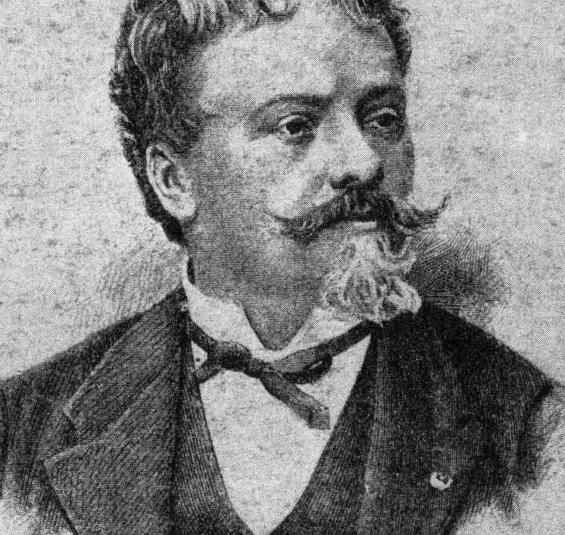
Alberto Pasini
Busseto 3 settembre 1826 - Cavoretto 15 dicembre 1899
He was born in Busseto on September 3, 1826, to Giuseppe Pasini and Adelaide Crotti Balestra; he lost his young father at the age of two and was taken to Parma under the guardianship of his uncle Antonio, an accomplished painter and collaborator of Bodoni.

At seventeen, Pasini enrolled in the Academy of Fine Arts in Parma, initially choosing the landscape department and later the drawing department. By the end of 1851, a combination of the political situation, a lack of work, and the confidence placed in him by the renowned Paolo Toschi prompted him to leave Parma for Paris. There, a stroke of luck—along with his remarkable graphic and expressive talents—gave him the opportunity to work at the leading French lithography studio, run by Charles and Eugène Ciceri. Pasini thus found himself immersed in one of the most stimulating and opportunity-rich environments of the 19th century's cultural capital.

His 1853 lithograph *La sera* (Evening) secured his first-ever admission to that year's Paris Salon; following this significant breakthrough, Pasini left the Ciceris and, in 1854, joined the studio of the prestigious Chassériau. Chassériau would shape Pasini's destiny by offering him the chance to step in as the designated artist for the diplomatic mission led by Minister Plenipotentiary Bourée, which was then departing for Persia.
The expedition left Europe in 1855 and arrived in the Persian capital, Tehran, where Pasini stayed for ten months; the return journey in 1856 took him across northern Persia and Armenia, finally reaching the port of Trebizond. During this extraordinary overland and maritime adventure, Pasini captured scenes with a keen eye and recorded them with lightning-fast hands, sketch after sketch, in small portable albums.

Pasini later drew upon this vast wealth of memories to bring to life—in his paintings—small Persian cafés, wild horseback rides, and long caravans.

By late 1859, he had embarked on a second journey to the Eastern Mediterranean; upon his return, he married Mariannina Celi of Borgotaro in 1860, and in 1862, their only child, Claire, was born in Paris.

In October 1867, Pasini temporarily left the studio he shared with Pittara and set off on another journey, this time to Constantinople. He returned to Turkey the following year to deliver four paintings commissioned specifically from him by Sultan Abdul Aziz—making him the first European painter to receive such a commission.

The war of 1870 prompted his return to Italy, where he settled in a large villa—the Rabajà—in Cavoretto, near Turin.

He attempted a fourth trip to Turkey in 1876; however, the Sultan's tragic death and the ensuing unrest halted his journey in Vienna. This interruption of his trip to Istanbul led Pasini to stop in Venice on his way back. From that point on, Venice fully took the place of the Orient for him.

He passed away in Cavoretto on December 15, 1899.

Alberto Pasini is considered the greatest Italian Orientalist painter. He operates within a context where an interest in and taste for exotic lands—particularly those of the Muslim world—had been developing for years.

Critics, even those most hostile to his exotic genre, appreciated his ability to render landscapes, architecture, and the lifelike arrangement of figures; he is noted above all for his masterful handling of light and space in backlit scenes.